


Keeping Pigeons Off The Balcony
Some people keep them as pets and others consider them a nice meal. To me they're just pests. The pigeons we find here flocking around buildings in urban centers were introduced to North America as pets from Europe and quickly adapted to urban living thanks to their cliff dwelling ancestry. Although their primary diet is grain, urban pigeons have no trouble finding food from the trash or a hand-out in the park. They are essentially scavengers. Communal birds that flock together and mate for life.
So what makes them so pesky. They're not that loud and certainly not aggressive or dangerous but they are capable of making a tremendous mess of your balcony. Their droppings carry quite a stench and even when dry, leave behind a residue that takes a bit of scrubbing to remove. Dust from these dried droppings can carry some nasty fungal diseases so for the health and welfare of yourself and others it is best to keep your balcony free of their mess.

The pigeon netting certainly makes it feel like it is more enclosed.

Every gap that the birds can possibly squeeze through has to be closed off.
I've seen people do a number of things to keep them away from their balcony. Some tie plastic bags to their railings with the idea being that the wind will rustle the bags and scare the pigeons away. But I think the pigeons figure that one out fairly quickly. You can purchase life-like plastic owls to perch on your railing; some with bobbing heads. I don't see many of those around though. I used to think that just constantly shooing them away and banging on the windows would be enough to make them feel uncomfortable and want to roost elsewhere. And for the most part, that works. Until they're ready to start a family.
They breed during all months of the year and lay one or two eggs per clutch. I would sometimes see pairs looking for places to nest on my balcony. They aren't too fussy. They will use whatever they can find on your balcony for nesting material. I've seen several swoop down and pull dead leaves and branches off old plants left from the previous season and take them away for nesting material. I even found one crude nest built from nothing more than a circle of 5 or 6 chop sticks. Once they settle on a nesting area they'll keep coming back to it since egg laying usually comes shortly after building a nest. They don't have much choice so even if you scare them off a number of times, they always seem to come back. You really need to remove all nesting materials from the area and close off any nooks they may find suitable for nesting. Boxes, lumber, garbage... plant containers, all create perfect little private nesting locations.
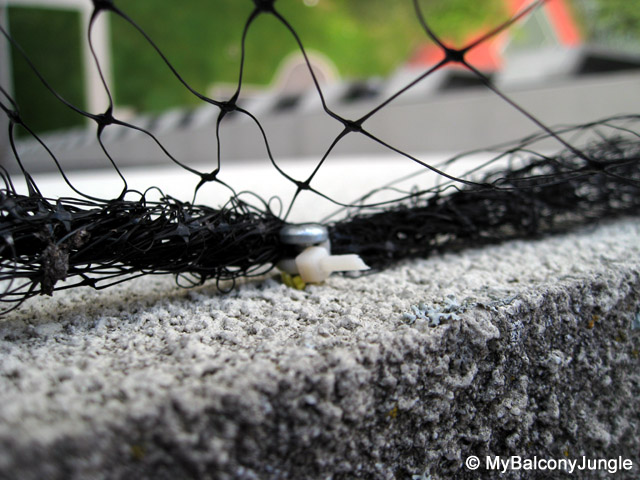
Netting anchored with a screw and cable tie.
Pigeons were always just a minor problem for us but at some point their numbers increased dramatically. It wasn't permitted at our condo but a few people decided to break the rules and install netting around their balconies. As more people did this, those without netting started to notice more birds. The condo board changed their policy and decided to let residents install netting but only if done properly. We held out as long as we could but as the pigeon numbers increased, we realized we too had to install the netting to reclaim our balcony space.
I called some guys in who specialize in pigeon netting installation. Business was booming for them that month at our building. Being on the top floor, the overhang over our balcony is much higher than on lower floors so I had to pay a bit more for wider netting. With nothing more than a rope tying off his harness to a support bolt that was part of my balcony, the installer stood on a little ladder working with a hammer drill over his head. Sometimes he had to put his feet on the outside wall of the balcony to get high enough to screw in the net anchors. The install probably wasn't as square as some balconies with lower overhangs but I had to give this guy credit - I could never have gotten up there and done what he did. The net went up quickly and almost instantly added 100 sq-ft to our 'usable' living space.

Our somewhat obstructed view of downtown Toronto.
The net is held in place by a number of anchor points along the inside edge of the overhang, along the walls and on the outside of the railing (half wall). Mostly screws in the concrete with a cable tie holding the netting to the screw head. A few key anchor locations use hooks with the net wrapped up into the hook and tied off. He made sure to enclose it completely, especially the little gap between the edge of the half wall and the ledge under the kitchen window. A number of times I've seen pigeons on that ledge, looking in through the netting. Good thing it's covered.
It almost felt like an enclosed space at first and without the constant swarm of birds swooping down on it, even leaving the balcony doors open felt alright. Sadly though it did take away from our view. You always notice the net when you're out there but I think it's a small price to pay. I've seen balconies with netting that was owner designed and installed and they look awful. Don't waste your time trying to save money on this one. Call a pro and have it done right. If you want to enjoy your balcony, it's worth the added expense.